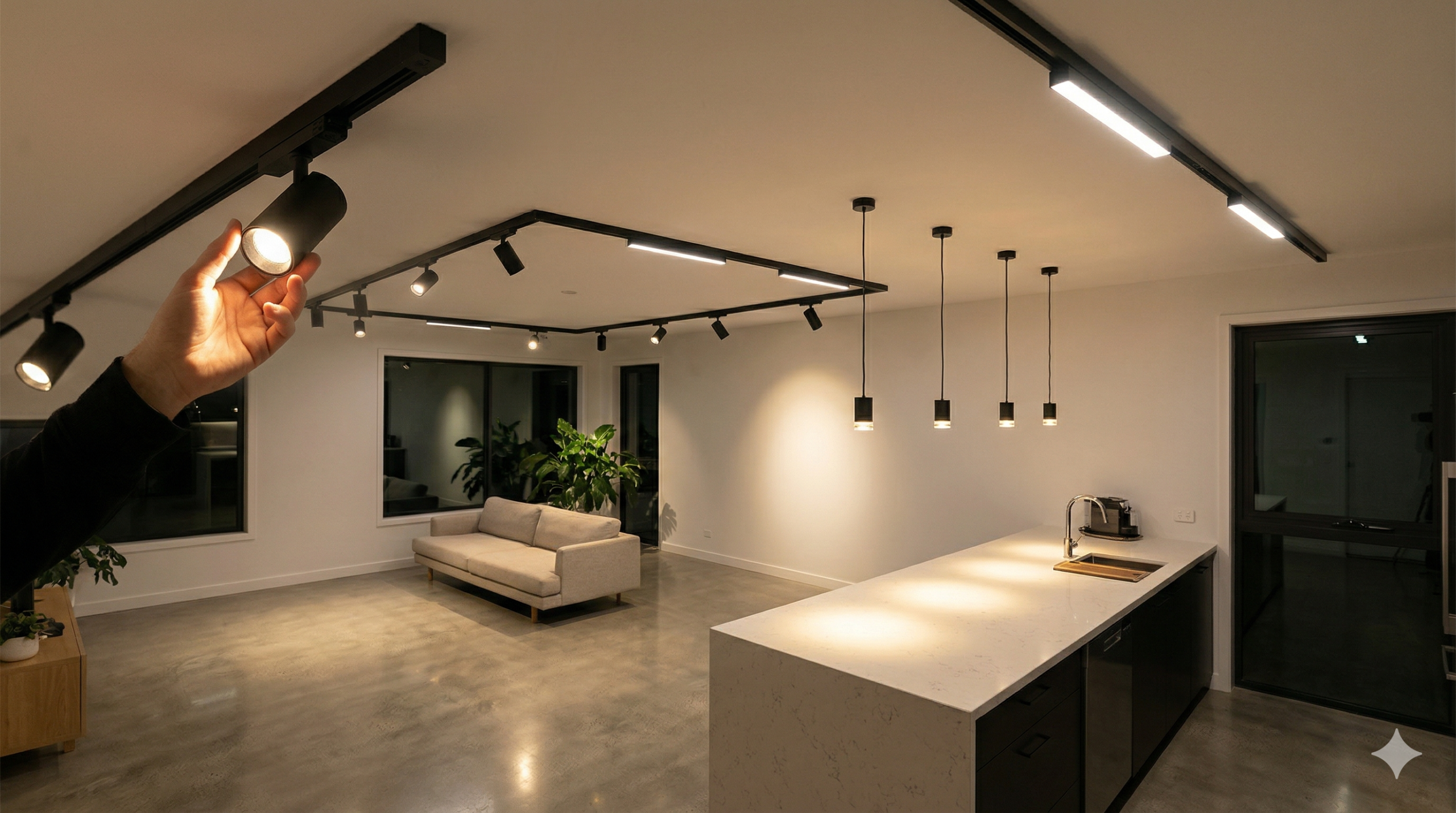
Magnetic LED spotlights are modern, flexible luminaires that can be removed and attached without tools onto specially designed magnetic track profiles using powerful magnets. Operating on safe 48V low-voltage technology, this innovative system offers the freedom to change the direction, angle and position of the light within seconds, making it possible to create dynamic, functional and flawless architectural solutions in interior designs.
Over more than twenty years of field experience in the lighting industry and in architectural projects, I have personally witnessed technology shed its mechanical constraints and evolve into a human-centered, flexible and dynamic form. With traditional lighting methods, we had to drill into the ceiling, pull new cables and lock luminaires into a fixed point. Today, however, control of the light and the spirit of the space are entirely in the user's hands. At the center of this revolution are, without doubt, magnetic infrastructures. When designing or renovating a space from scratch, the lighting infrastructure must be able to meet not just today's needs but also tomorrow's instantly changing ones. This is where digging into the details of magnetic systems, which will take the quality of your projects up a level, is the most vital step toward making sound, long-term decisions.
How Do Magnetic LED Spotlights Work? Technological Infrastructure and System Components
The most important engineering achievement at the heart of this innovative technology is the 48V DC (direct current) low-voltage infrastructure, which brings together user safety and mechanical functionality. The 220V mains voltage used in older traditional systems carries a serious risk of electric shock when luminaires are swapped, and requires that this work always be done by a licensed electrician. In magnetic systems running on 48V, this vital risk is completely eliminated. Even while the track system is active, that is, while there is power on the line, touching the track with your hand or a luminaire poses no danger. This gives the end user tremendous freedom to modify the design themselves.
Looking more closely at how the mechanical locking and electrical connection are achieved, the inner walls of the track profiles, made of extruded aluminum, contain continuous pure copper conductor busbars. Magnetic LED spotlights, in turn, have high-holding-force neodymium magnets and spring-loaded contact pins in their bases. The moment you gently push the luminaire into the track, the magnets lock it into the profile instantly with a very strong pull. At the same time, the spring-loaded pins make perfect contact with the copper busbars and complete the electrical circuit within seconds. Thanks to this plug-and-play mechanism, changing the lighting scenario of the space becomes child's play. You do not need a screwdriver, terminal blocks, or any mess on the ceiling.
The Most Popular Magnetic LED Spotlights and Models in Architectural Design
The most striking feature that makes these systems superior to traditional lighting is that lighting modules with entirely different optical functions and designs can be used together, at the same time, on a single power line (track). Every space has a different volume, lighting need and focal point. Getting to know the modules that are most widely preferred in high-end architectural projects is very important for creating the right lighting concept.
Adjustable Focusing (Accent) Spotlights: With narrow, sharp beam angles typically of 15°, 24° or 36°, these models are used to highlight a specific object, a valuable painting, a plant or an architectural texture in the space. Able to rotate 360 degrees around their own axis and tilt 90 degrees vertically, these magnetic LED spotlights lock the light onto the target with pinpoint precision.
Linear Modules with Opal Diffusers: With wide-angle (typically 120 degrees) matte opal covers, these models carry the general (ambient) lighting load of the space. They spread light across the entire room in a homogeneous, soft and eye-friendly way, preventing harsh shadows.
Dark Light (Glare-Controlled) Honeycomb Spotlights: These models contain special black reflectors resembling a honeycomb texture, shielding the light source from direct eye contact. You clearly feel the presence of brightness in the space, but when you look at the ceiling you cannot tell at first glance where the light source is (because you experience no glare). It is the peak of visual comfort.
Foldable Adjustable Modules: These compact, aesthetically brilliant products can fold out 90 degrees from the track and be aimed when needed, and when not in use they tuck back into the track, forming a flat line flush with the ceiling.
Spotlights with Pendant Adapters: They are used especially where light needs to be brought closer to the work surface, such as dining tables and kitchen islands in homes or bar counters in commercial spaces. Filling the vertical volume of the ceiling, they add depth and character to the space.
Asymmetric Wallwasher Luminaires: These models wash light not onto the floor of the space but directly onto the wall surface at an asymmetric, balanced angle. This application creates an optical illusion that makes walls appear much wider and ceilings higher than they are.
Optical and LSI Criteria to Consider When Choosing Magnetic LED Spotlights
Lighting planning is not just about making a space visible; it is also a technical discipline that directly affects human psychology, biological rhythm and the overall perception of the space. When choosing a system, you should evaluate the optical performance of the LED chip inside rather than the look of the luminaire's outer housing. Being able to read these technical LSI (semantic) specifications correctly makes the difference between a quality project and an ordinary one.
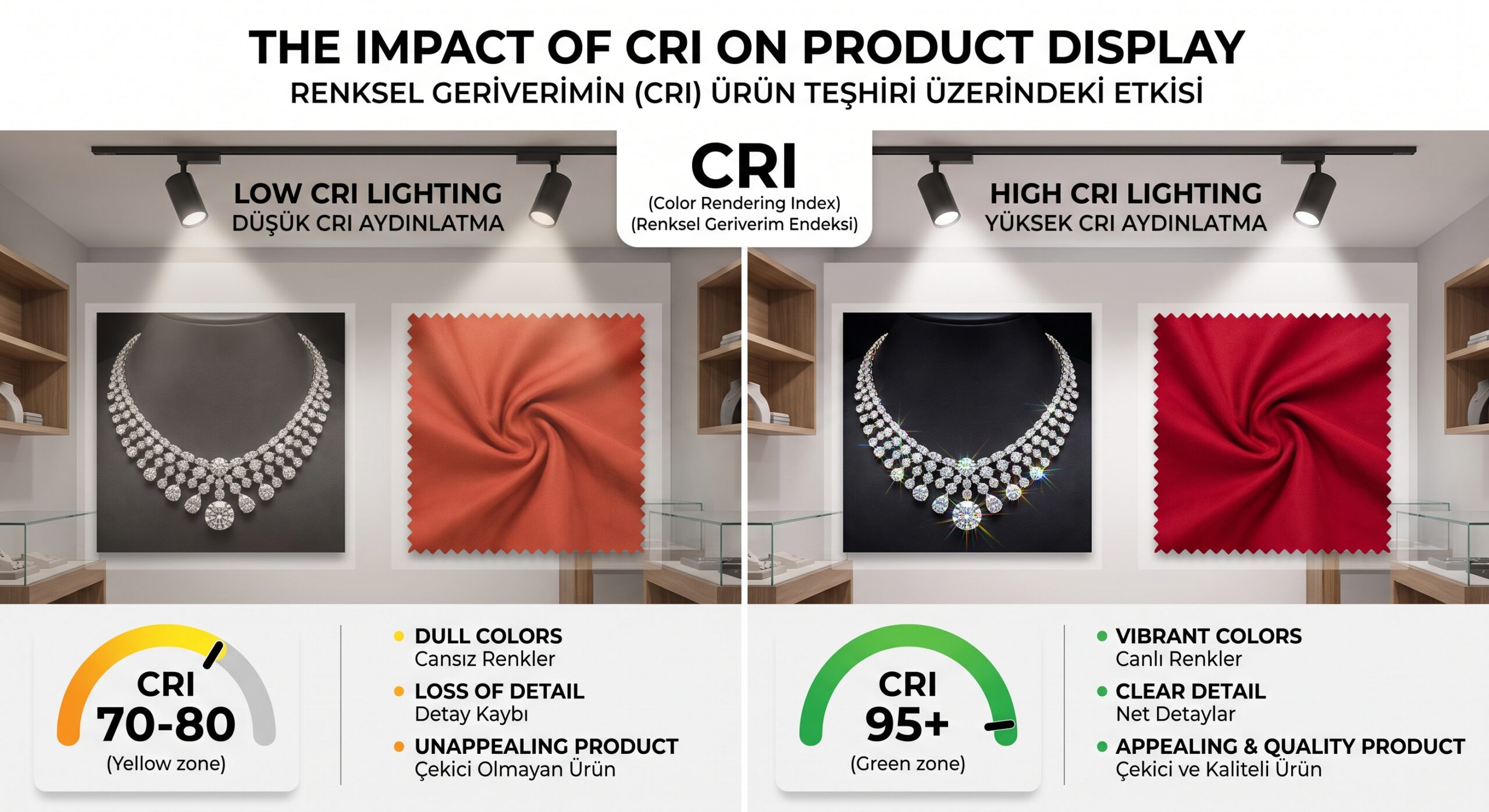
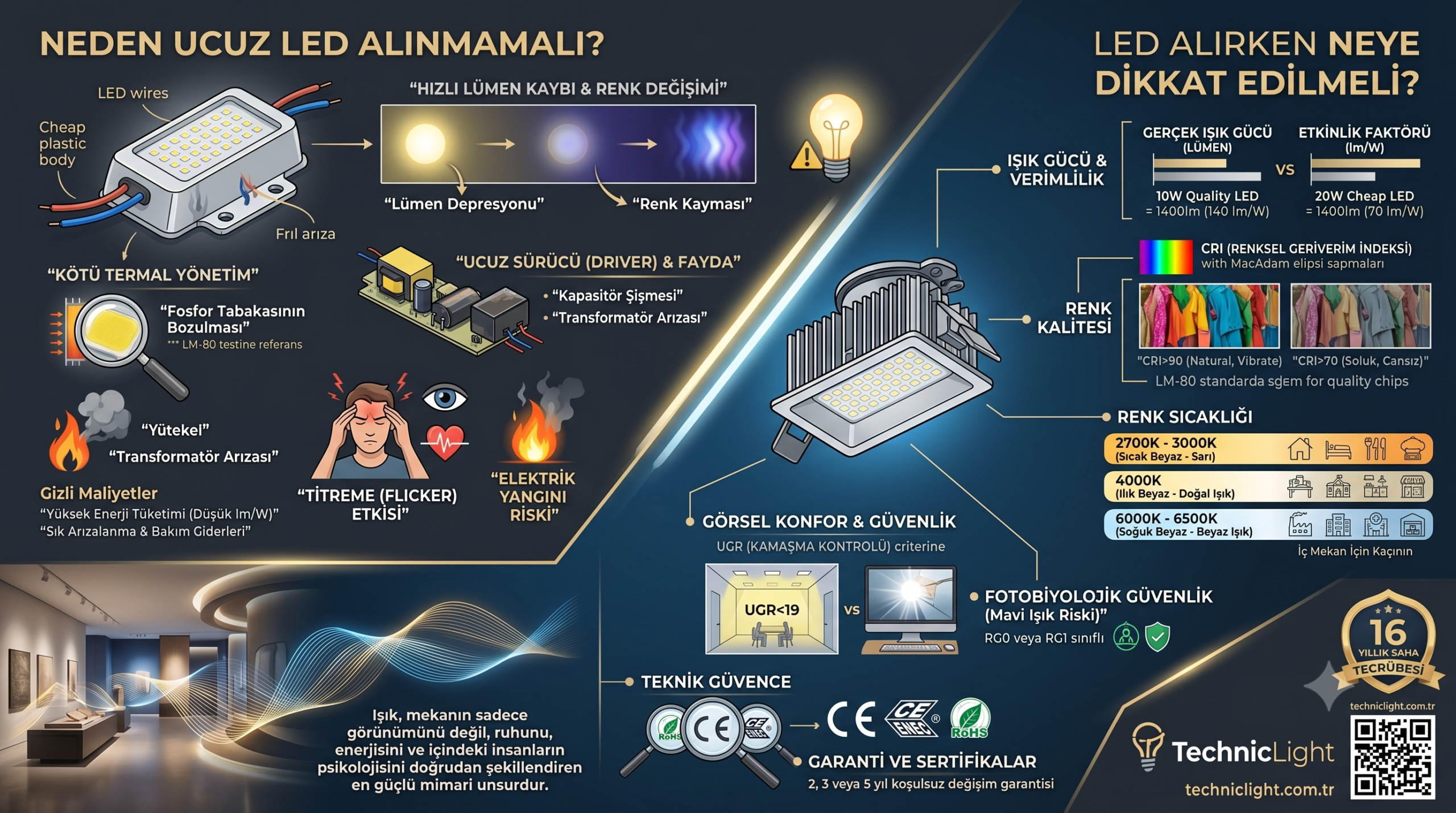
The first and most critical value is the Color Rendering Index, or CRI. The pure CRI value of sunlight is taken as 100. The closer the magnetic LED spotlights you buy are to this 100, the more naturally and vividly they show the true colors of the objects they illuminate. In areas where color accuracy is vital, such as textile stores, museums, art galleries and kitchen countertops at home, the CRI of the spotlights must be 90 or above (CRI>90, preferably CRI 95+). Low-quality luminaires with a low CRI value make the space look pale like a hospital, dull the texture of wooden furniture and wipe out the appeal of products in stores.
Another important metric is Color Temperature (Kelvin). In living rooms, luxury restaurants or hotel lobbies, where a feeling of rest, relaxation and intimacy is the priority, warm white (yellowish) tones in the 2700K to 3000K range should be preferred. In active spaces such as offices, clinics or supermarkets, where focus and efficiency must be at their maximum, 4000K natural daylight (neutral white) tones should be chosen. In addition, a UGR (Unified Glare Rating) value below 19 is an international standard for preventing eye strain (asthenopia), especially in areas where computers are used.
How Should Magnetic LED Spotlights Be Planned for Different Application Areas?
The modular structure of magnetic lighting systems allows this technology to deliver flawless results in very different types of spaces. The dynamics of each building, user habits and decorative language are entirely different from one another. For this reason, area-specific strategies should be developed in projects rather than a one-size-fits-all formula.
Aesthetic Harmony with Magnetic LED Spotlights in Residential and Living Spaces
In modern luxury residential architecture, crowded chandeliers that burden the ceiling are increasingly giving way to minimalist lines. In living rooms, flawless black lines are created using trimless tracks hidden flush within the plasterboard. While opal linear luminaires that do not tire the room are used for general lighting, adjustable magnetic LED spotlights aimed behind the TV unit, at books on the shelves or at special sculptures give the space dramatic depth. In this way, your home evokes the feeling of an art gallery rather than ordinary lighting.
Sales-Focused Magnetic LED Spotlights in Retail
In the retail world, the right light is the quiet but most effective salesperson. Window concepts, mannequin positions, seasonal sales and shelf layouts are in constant rotation in stores. Old-style spotlights fixed to the ceiling cannot keep up with this fast change and leave new collections in the dark. Thanks to magnetic systems, store staff can slide the lighting onto new products instantly, narrowing and widening the angles, without waiting for an electrician. Moreover, the almost negligible heat emitted by quality LED technology prevents textile colors from fading and food products from spoiling.
Magnetic LED Spotlights in Corporate Offices and Workspaces
In open-plan offices, employees' biggest complaint is the glare that ceiling lighting creates on computer screens. This leads to serious headaches and loss of focus during working hours. Dark light magnetic LED spotlights with a honeycomb texture, used on office ceilings, direct the light homogeneously onto the desk surface rather than onto the screens. In meeting rooms, pendant magnetic modules illuminating the center of the table focus attention on a single point while projecting a professional corporate image.
What Advantages Do Magnetic LED Spotlights Offer Compared with Traditional Systems?
Beyond the practicality the technology offers, there are very solid rational and economic reasons that make these systems worth the investment. The life of traditional spot luminaires generally depends on the quality of the bulb used and requires frequent bulb changes. Magnetic luminaires, on the other hand, use high-quality LED chips (COB or SMD) integrated inside. The average life of these chips is over 50,000 hours. Even in a store or office that burns an average of 10 hours a day, this means more than 13 years of maintenance-free use.
In addition, energy efficiency (lumen/watt ratio) is up to 80% higher than that of traditional halogen or older-generation fluorescent lighting. Thanks to their modular structure, if a part of the system fails (for example, a single spotlight breaks down), only that spotlight can be replaced with a new one within seconds, without having to dismantle the entire infrastructure or the ceiling. This minimizes failure maintenance and repair costs and lost time for businesses.
Infrastructure Installation and Engineering Calculations for Magnetic LED Spotlights
For the system to look flawless in architectural projects and to operate reliably for many years, correct engineering calculations must be made at the initial installation stage. Track profiles come in three main mounting types: “Recessed (Trimless)” profiles that sit completely within the plasterboard, “Surface-Mounted” profiles screwed directly onto a concrete or wooden ceiling, and “Pendant” profiles suspended on steel cables in high-ceilinged spaces. For recessed (trimless) mounting in particular, the plasterboard installer and the electrical team must work in coordination with millimeter-precise measurements.
The most critical issue on the electrical engineering side is the correct sizing of the transformer (power supply/driver) that will feed the system. When designing the system, the total wattage consumption of all magnetic LED spotlights and linear luminaires planned for the track must be added up, and the capacity of the 48V transformer you choose must be at least 20% above this total (safety margin). Otherwise, the transformer will constantly run hot at full load and burn out in a short time. In addition, on long, uninterrupted runs exceeding 10 meters, “voltage drop” is a law of physics. To prevent the voltage from weakening toward the end of the run, the system must be reinforced with parallel feed cables from the ends and midpoints of long tracks.
Smart Home Systems and Automation-Ready Magnetic LED Spotlights of the Future
Today, physical flexibility has merged with the limitless intelligence of the digital world. Turning lights on and off with a standard wall switch is increasingly outdated. New-generation smart magnetic LED spotlights, equipped with global communication protocols such as DALI (Digital Addressable Lighting Interface), Zigbee, Bluetooth Mesh or Casambi, work fully integrated with the space's automation brain.
Thanks to this smart integration, from your smartphone app or tablet you can select each spotlight on the track individually, dim it flicker-free from 1% to 100%, or switch it off. When you use spotlights with “Tunable White” technology, you can write circadian rhythm scenarios that automatically shift from energizing 4000K cool white in the morning to 2700K warm yellow tones in the evening to boost melatonin secretion. Compatible with voice assistants, these infrastructures turn lighting from a static product into a living ecosystem that interacts with your life.
The experience I have gained in countless projects has shown me very clearly that light does much more than dispel the darkness of a room. It builds the character of the space, hides flaws, elevates beauty and directly touches the mood of the people who live there. The tremendous flexibility offered by magnetic systems, where technology meets engineering and elegance, completely removes the barriers to your imagination as a designer and homeowner. As you shape your living spaces or commercial projects, I recommend seeing lighting not as a detail left for later but as the heart of the space. When you experience this sense of freedom, adapting instantly to your changing needs, in your own spaces, you will deeply feel the warm and positive energy that the right light brings to your life.