The clearest answer to the question of why you should not buy cheap LEDs and what to look for when buying LEDs is to avoid irreparable safety vulnerabilities and architectural disasters. Back-alley lighting products that seem to save money at first, with weak cooling technology and unqualified electronic drivers, quickly lose light output and darken spaces, produce stroboscopic flicker that threatens eye health, and leave buildings facing serious electrical fire risk.
The Destruction of Spatial Perception: Why Architectural Designs Fall Apart
Imported marble, premium wood veneers and expensive textiles, carefully chosen after months of design meetings and great enthusiasm, can suddenly lose all their appeal on the day the site is handed over. The only reason behind this is the poor-quality light sources shining on the ceilings. Lighting is an interpreter that conveys the texture, depth and material quality of a space to the human brain. A low-grade LED luminaire mistranslates it with its flawed light spectrum.
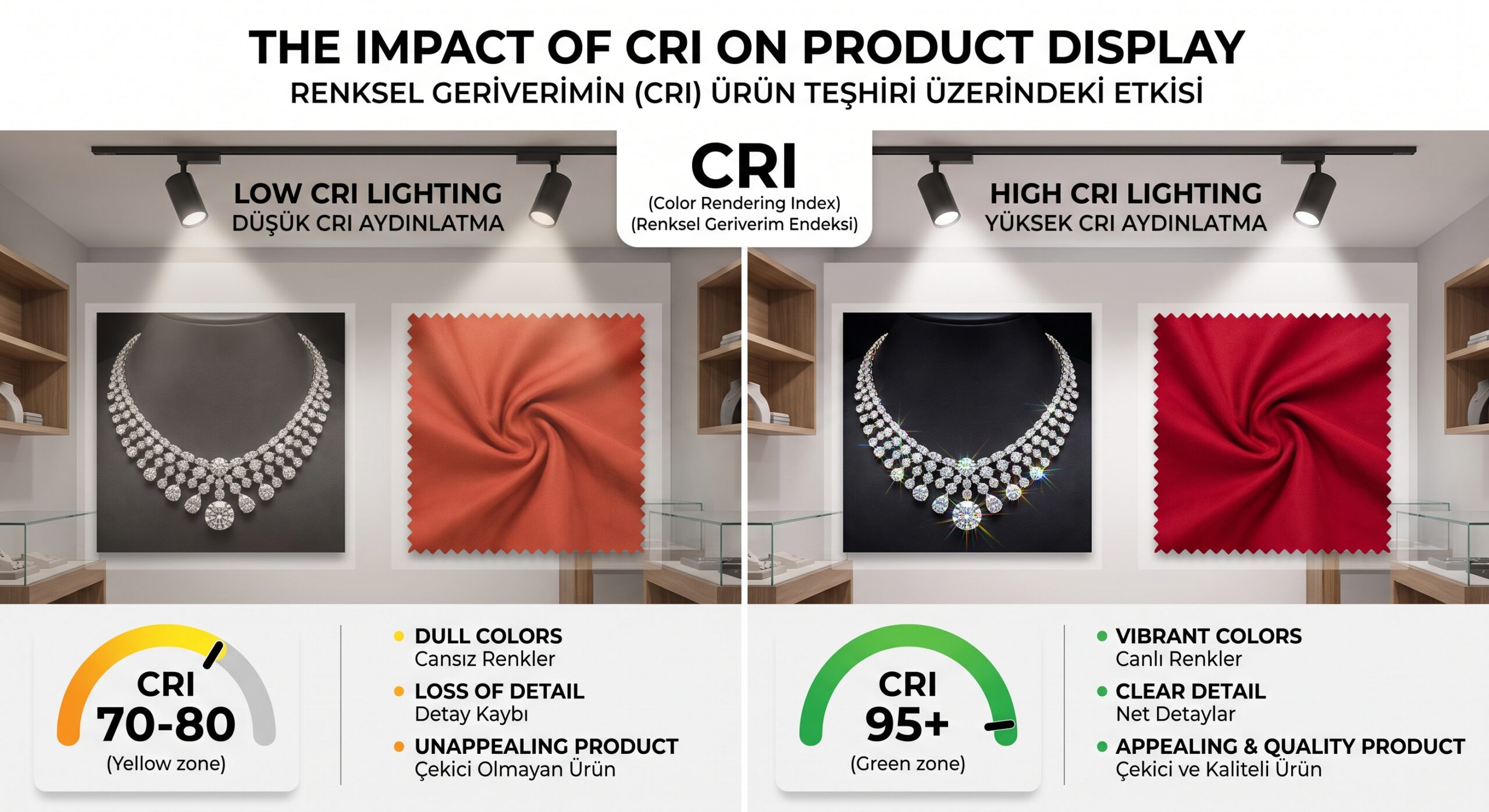
Products made under cost pressure and put on the market through subcontracting in particular have enormous gaps in their color spectrum. These products, whose red, green and blue wavelengths are missing or unbalanced, make rich mahogany look like lifeless plastic and a vivid red fabric look like a faded burgundy. The cause of this aesthetic collapse in architectural projects is the weak photometric structure of the luminaires used. Without a quality lighting design, the millions of liras you invest in the decoration budget of a space are doomed to be lost in the dark or under the wrong light.
Physical Collapse: Thermal Stress and Chip Darkening in Photon Production
Unlike old-generation bulbs, LED (Light Emitting Diode) technology produces photons not by burning a filament but by passing current through a semiconductor material. This process, based on quantum mechanics, requires incredibly precise thermal management. The biggest engineering trick in cheaply sold products is avoiding the cost of the heatsink. Instead of dense, solid aluminum profiles, manufacturers use painted plastic housings or very thin sheet metal to make products seem heavy and sturdy.
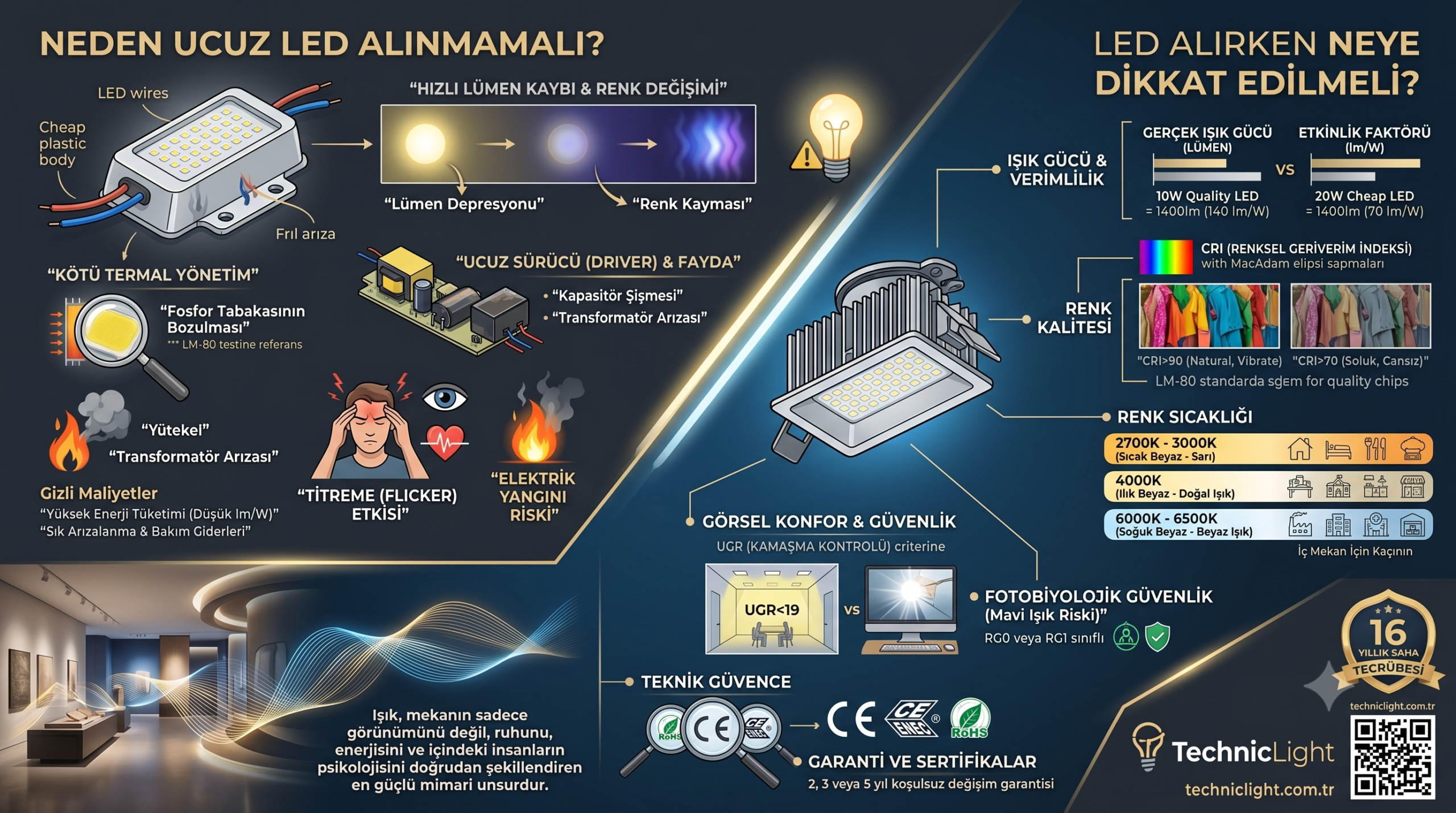
But the laws of physics can never be fooled. The heat generated when the LED chip starts operating cannot be dissipated, so it accumulates on the chip itself. The chip core temperature, called “Junction Temperature,” exceeds critical limits within just a few hours. This excessive heat first scorches the yellow phosphor layer that gives the light its color. After only a few months, the product's bright white color shifts to a dead purple or greenish tone. As the heat keeps rising, the solder joints on the circuit board liquefy and crack, and the chip goes completely dark and becomes unusable. The price of a product being cheap is that you have bought electronic waste that will end up in the trash within months.
Technology Clashing with the Mains: Why Does the Driver Burn Out?
The biggest secrets of the lighting industry are hidden in the small electronic boxes you cannot see inside the luminaire. The electricity coming from the outlets in our homes and from the grid is constantly fluctuating, high-pressure 220V alternating current (AC). LED chips, on the other hand, are delicate circuit elements that run on very low, strictly constant direct current (DC). The system that converts mains electricity into something gentle enough for an LED to consume is the “Driver” unit.
Non-Isolated Circuits and Violent Explosions
In back-alley production, instead of safe, isolated transformers, extremely primitive and cheap capacitive circuits are used that try to reduce the current from the mains with resistors alone. These circuits are completely defenseless against momentary voltage spikes in the grid. On a rainy day, or with a small voltage fluctuation from the transformer, the low-quality capacitors inside the driver swell and burst instantly. If the luminaire is inside a suspended ceiling, next to wooden framing or easily ignitable insulation materials, this explosion turns into an irreversible roof fire within seconds. A single current protection relay left out to cut costs is a threat big enough to reduce an entire building to ashes.
Circadian Rhythm and Biological Damage: The Health Effects of Poor-Quality Light
Lighting determines the quality not only of a space but of the people who live in it. The most insidious harm of poor-quality lighting is the damage it does to human biology. The human brain and hormones have been programmed for millions of years according to the color and quality of light.
Stroboscopic Fluctuation and Neurological Stress (Flicker)
The low-quality drivers mentioned above cannot fully smooth out the 50-60 times per second fluctuation of the city grid. This means the light constantly blinks like a strobe (a disco ball), even though it is not clearly noticeable to the naked eye. This “Flicker” effect continuously sends signals through the retina to the brain's visual center. In people who work for hours under this flickering light in environments such as offices or hospitals, chronic headaches of unknown cause, dry eyes, nausea and severe loss of concentration begin. A quality lighting luminaire should have “Flicker-Free” drivers and safeguard eye health.
The Dazzling Glare Problem (UGR)
Lighting that does not tire the eyes depends on directing the photons leaving the light source with the right optical lenses. Because cheap products use flat, low-quality diffusers, the light hits the human eye head-on. This glare effect (UGR – Unified Glare Rating) creates blinding reflections, especially when working on computer screens. In professional architectural lighting, the light source is distributed with micro-prismatic optics or deeply recessed reflectors (dark-light) so that the light source itself is invisible even when the space is bright.
A Lighting Procurement Specification for Professional Partners
To avoid disappointment in your projects and to plan your budget correctly, in procurement you need to focus not on product packaging but on laboratory test data. Whether it is a large hotel project or a boutique cafe design, you should look for the following firm requirements in any lighting product put on the table:
1. Lumen / Watt (Efficacy) Optimization
Watts are only a line item of cost; light is measured in lumens. The quality of a luminaire is measured by how many lumens it produces per watt it consumes. By today's professional engineering standards, a product's efficacy should be at least between 100 and 130 lumens per watt. If the product offered to you draws 20W and gives only 1200 lumens (60 lm/W), it is converting electricity into heat, not light, and should be removed from the project immediately.
2. The CRI Standard for Color Accuracy
The Color Rendering Index is considered the heart of lighting. The closer this value is to 100, the more natural objects' colors look, as in sunlight. For home projects and standard offices, you should never go below CRI 80. If your project is a fresh food section, an art gallery, a textile store or a high-end restaurant, the products used must have a value of CRI 90 or above, and the “R9” parameter, which renders human skin and red tones accurately, must also be high.
3. Kelvin Distribution According to the Function of the Space
The spectral temperature of light determines the spirit of a space. For rest, pre-sleep and comfort areas (for example bedrooms, hotel lobbies and luxury restaurants), the 2700K to 3000K (Warm White) range should be preferred to relax the parasympathetic nervous system. In offices, schools and hospitals, which demand clarity, work discipline and high attention, 4000K (Natural Neutral White) is the gold standard. Using 6000K-6500K (Cool White) in indoor projects to give a sense of alertness is a major design mistake, because its high blue content disrupts the biological clock and creates stress.
4. Independent Test Laboratory Certifications
Products you will use in large projects must carry LVD and EMC test reports indicating compliance with European Union standards. In particular, the ENEC certificate is the most prestigious indicator that a product's electrical safety has been tested and approved by an independent body. For dusty or wet areas (bathrooms, facades, car parks), the products' having the right IP (Ingress Protection) rating and the quality of their sealing gaskets also determine the lifespan of the project.
The experience I have gained in the kitchen of countless prestigious projects we have carried out for more than 16 years on dusty construction sites and with architectural teams has taught me one unchanging law: Light is the most powerful architectural element, directly shaping not only the appearance of a space but its soul, its energy and the psychology of the people in it. At the end of the day, a poor-quality lighting system that is assumed to be cheap will damage your brand's prestige with its degraded atmosphere, create high operating and service costs with its constantly failing luminaires, and cost you sleep with its safety vulnerabilities. Lighting is not a simple accessory that can be added to a space afterward; on the contrary, it is the fundamental load-bearing system that carries the entire design on its shoulders. Treating lighting as a technical science is our greatest responsibility, in order to bring the potential of your architectural projects to the maximum and to create flawless atmospheres that will be lived in with confidence and pleasure for years. On the journey of building sustainable and aesthetic projects designed with the right values, we will always be glad to guide you with this deep engineering heritage of ours.
Why You Should Not Buy Cheap LEDs and What to Look for When Buying LEDs: Firm Rules for Proper Lighting
The clearest answer to the question of why you should not buy cheap LEDs and what to look for when buying LEDs is to avoid irreparable safety vulnerabilities and architectural disasters. Back-alley lighting products that seem to save money at first, with weak cooling technology and unqualified electronic drivers, quickly lose light output and darken spaces, produce stroboscopic flicker that threatens eye health, and leave buildings facing serious electrical fire risk.
The Destruction of Spatial Perception: Why Architectural Designs Fall Apart
Imported marble, premium wood veneers and expensive textiles, carefully chosen after months of design meetings and great enthusiasm, can suddenly lose all their appeal on the day the site is handed over. The only reason behind this is the poor-quality light sources shining on the ceilings. Lighting is an interpreter that conveys the texture, depth and material quality of a space to the human brain. A low-grade LED luminaire mistranslates it with its flawed light spectrum.
Products made under cost pressure and put on the market through subcontracting in particular have enormous gaps in their color spectrum. These products, whose red, green and blue wavelengths are missing or unbalanced, make rich mahogany look like lifeless plastic and a vivid red fabric look like a faded burgundy. The cause of this aesthetic collapse in architectural projects is the weak photometric structure of the luminaires used. Without a quality lighting design, the millions of liras you invest in the decoration budget of a space are doomed to be lost in the dark or under the wrong light.
Physical Collapse: Thermal Stress and Chip Darkening in Photon Production
Unlike old-generation bulbs, LED (Light Emitting Diode) technology produces photons not by burning a filament but by passing current through a semiconductor material. This process, based on quantum mechanics, requires incredibly precise thermal management. The biggest engineering trick in cheaply sold products is avoiding the cost of the heatsink. Instead of dense, solid aluminum profiles, manufacturers use painted plastic housings or very thin sheet metal to make products seem heavy and sturdy.
But the laws of physics can never be fooled. The heat generated when the LED chip starts operating cannot be dissipated, so it accumulates on the chip itself. The chip core temperature, called “Junction Temperature,” exceeds critical limits within just a few hours. This excessive heat first scorches the yellow phosphor layer that gives the light its color. After only a few months, the product's bright white color shifts to a dead purple or greenish tone. As the heat keeps rising, the solder joints on the circuit board liquefy and crack, and the chip goes completely dark and becomes unusable. The price of a product being cheap is that you have bought electronic waste that will end up in the trash within months.
Technology Clashing with the Mains: Why Does the Driver Burn Out?
The biggest secrets of the lighting industry are hidden in the small electronic boxes you cannot see inside the luminaire. The electricity coming from the outlets in our homes and from the grid is constantly fluctuating, high-pressure 220V alternating current (AC). LED chips, on the other hand, are delicate circuit elements that run on very low, strictly constant direct current (DC). The system that converts mains electricity into something gentle enough for an LED to consume is the “Driver” unit.
Non-Isolated Circuits and Violent Explosions
In back-alley production, instead of safe, isolated transformers, extremely primitive and cheap capacitive circuits are used that try to reduce the current from the mains with resistors alone. These circuits are completely defenseless against momentary voltage spikes in the grid. On a rainy day, or with a small voltage fluctuation from the transformer, the low-quality capacitors inside the driver swell and burst instantly. If the luminaire is inside a suspended ceiling, next to wooden framing or easily ignitable insulation materials, this explosion turns into an irreversible roof fire within seconds. A single current protection relay left out to cut costs is a threat big enough to reduce an entire building to ashes.
Circadian Rhythm and Biological Damage: The Health Effects of Poor-Quality Light
Lighting determines the quality not only of a space but of the people who live in it. The most insidious harm of poor-quality lighting is the damage it does to human biology. The human brain and hormones have been programmed for millions of years according to the color and quality of light.
Stroboscopic Fluctuation and Neurological Stress (Flicker)
The low-quality drivers mentioned above cannot fully smooth out the 50-60 times per second fluctuation of the city grid. This means the light constantly blinks like a strobe (a disco ball), even though it is not clearly noticeable to the naked eye. This “Flicker” effect continuously sends signals through the retina to the brain's visual center. In people who work for hours under this flickering light in environments such as offices or hospitals, chronic headaches of unknown cause, dry eyes, nausea and severe loss of concentration begin. A quality lighting luminaire should have “Flicker-Free” drivers and safeguard eye health.
The Dazzling Glare Problem (UGR)
Lighting that does not tire the eyes depends on directing the photons leaving the light source with the right optical lenses. Because cheap products use flat, low-quality diffusers, the light hits the human eye head-on. This glare effect (UGR – Unified Glare Rating) creates blinding reflections, especially when working on computer screens. In professional architectural lighting, the light source is distributed with micro-prismatic optics or deeply recessed reflectors (dark-light) so that the light source itself is invisible even when the space is bright.
A Lighting Procurement Specification for Professional Partners
To avoid disappointment in your projects and to plan your budget correctly, in procurement you need to focus not on product packaging but on laboratory test data. Whether it is a large hotel project or a boutique cafe design, you should look for the following firm requirements in any lighting product put on the table:
1. Lumen / Watt (Efficacy) Optimization
Watts are only a line item of cost; light is measured in lumens. The quality of a luminaire is measured by how many lumens it produces per watt it consumes. By today's professional engineering standards, a product's efficacy should be at least between 100 and 130 lumens per watt. If the product offered to you draws 20W and gives only 1200 lumens (60 lm/W), it is converting electricity into heat, not light, and should be removed from the project immediately.
2. The CRI Standard for Color Accuracy
The Color Rendering Index is considered the heart of lighting. The closer this value is to 100, the more natural objects' colors look, as in sunlight. For home projects and standard offices, you should never go below CRI 80. If your project is a fresh food section, an art gallery, a textile store or a high-end restaurant, the products used must have a value of CRI 90 or above, and the “R9” parameter, which renders human skin and red tones accurately, must also be high.
3. Kelvin Distribution According to the Function of the Space
The spectral temperature of light determines the spirit of a space. For rest, pre-sleep and comfort areas (for example bedrooms, hotel lobbies and luxury restaurants), the 2700K to 3000K (Warm White) range should be preferred to relax the parasympathetic nervous system. In offices, schools and hospitals, which demand clarity, work discipline and high attention, 4000K (Natural Neutral White) is the gold standard. Using 6000K-6500K (Cool White) in indoor projects to give a sense of alertness is a major design mistake, because its high blue content disrupts the biological clock and creates stress.
4. Independent Test Laboratory Certifications
Products you will use in large projects must carry LVD and EMC test reports indicating compliance with European Union standards. In particular, the ENEC certificate is the most prestigious indicator that a product's electrical safety has been tested and approved by an independent body. For dusty or wet areas (bathrooms, facades, car parks), the products' having the right IP (Ingress Protection) rating and the quality of their sealing gaskets also determine the lifespan of the project.
The experience I have gained in the kitchen of countless prestigious projects we have carried out for more than 16 years on dusty construction sites and with architectural teams has taught me one unchanging law: Light is the most powerful architectural element, directly shaping not only the appearance of a space but its soul, its energy and the psychology of the people in it. At the end of the day, a poor-quality lighting system that is assumed to be cheap will damage your brand's prestige with its degraded atmosphere, create high operating and service costs with its constantly failing luminaires, and cost you sleep with its safety vulnerabilities. Lighting is not a simple accessory that can be added to a space afterward; on the contrary, it is the fundamental load-bearing system that carries the entire design on its shoulders. Treating lighting as a technical science is our greatest responsibility, in order to bring the potential of your architectural projects to the maximum and to create flawless atmospheres that will be lived in with confidence and pleasure for years. On the journey of building sustainable and aesthetic projects designed with the right values, we will always be glad to guide you with this deep engineering heritage of ours.